On-Site Headshot Booths for NYC Corporate Events in 2026: How They Actually Work
# On-Site Headshot Booths for NYC Corporate Events in 2026: How They Actually Work
Somewhere in the planning doc for your next company offsite, all-hands, or conference, there is a line item nobody fully understands: "headshot station." It usually gets added because someone remembered that half the team has a LinkedIn photo from a wedding, cropped at the shoulder of a person who is no longer in the picture. The intent is right. The execution is where it falls apart, because most planners have never seen how a headshot booth actually runs inside a live event.
I run these stations at corporate events around New York City, and the mechanics are more specific than people expect. This is a working guide to how an on-site headshot booth works: what it takes to set up, how many people you can realistically photograph in an hour, what the photos look like, and how they get delivered. If you already know you want one for an upcoming event, you can book your session and we'll scope it together. If you're still deciding whether it's worth the floor space, read on.
What an on-site headshot booth actually is
An on-site headshot booth is a self-contained studio that gets built inside your venue for the duration of an event. It is not a ring light on a tripod next to the coffee station. A proper setup includes a portable backdrop, two or three lights with modifiers, a tethered camera, and enough floor space for a person to stand six to eight feet from the background without casting a shadow on it.
The point of the booth is consistency. Everyone who steps in front of it gets the same light, the same background, and the same framing, so when 40 headshots land in the company drive, they look like they belong to one organization rather than 40 different phones. That consistency is the entire reason to bring in a photographer instead of asking people to take turns with someone's iPhone in a conference room.
Booths show up at a predictable set of NYC events: sales kickoffs, leadership offsites, employee onboarding days, industry conferences, member-association mixers, and recruiting events where the company wants every new hire walking out with a usable photo. The common thread is a room full of professionals who all need the same thing at the same time. If that sounds like your event, a structured team headshots plan is usually the right starting point, because pricing and logistics work differently when you're shooting a group versus one person.
How the booth gets set up
The setup is the part planners worry about most, and it's the part I've made boring on purpose. Here's the realistic sequence for a typical NYC venue.
- Scout and confirm the corner. A week out, I need the room dimensions and a photo of the proposed spot. A headshot booth needs roughly a 10-by-10-foot footprint and one standard power outlet. Corners are ideal because they keep foot traffic from walking through frames.
- Load-in and build. I arrive 60 to 90 minutes before the booth opens. Backdrop stand, lights, and camera go up first; then I calibrate the light to the room and shoot test frames on a stand-in.
- Lock the look. Before the first guest, the exposure, background tone, and framing are fixed. From that point, every photo matches.
- Run the line. Guests step in, I direct them through three or four expressions in about 90 seconds, and they step out.
- Strike. Teardown takes about 30 minutes. The room goes back to how it was, with no marks on the floor or walls.
The whole thing is designed to be invisible to the event itself. Nobody should notice the booth except the people standing in line for it, and that line moves faster than they expect.
Throughput: how many people can you really photograph?
This is the number that determines whether a booth is worth it for your event, so it deserves a straight answer.
At a comfortable pace, a single photographer can shoot 20 to 25 people per hour with directed posing and a quick review on the screen. Push to a faster, conveyor-style flow (fewer expressions, no on-screen review) and you can reach 30 to 40 per hour, but the photos start to feel rushed and people leave less happy. For a 100-person company event, that means a four-hour booth at a relaxed pace, or a two-photographer setup running in parallel if you want everyone done in two hours.
The mistake I see most often is under-booking the window. A planner allots one hour for a 150-person headshot station, the line backs up past the catering, and people give up. The fix is simple math: divide your headcount by 20, add a buffer, and that's your booth hours. If the event has a hard end time, run two stations. I'd rather talk you out of an impossible window than show up to a line that can't physically clear.
What the photos look like
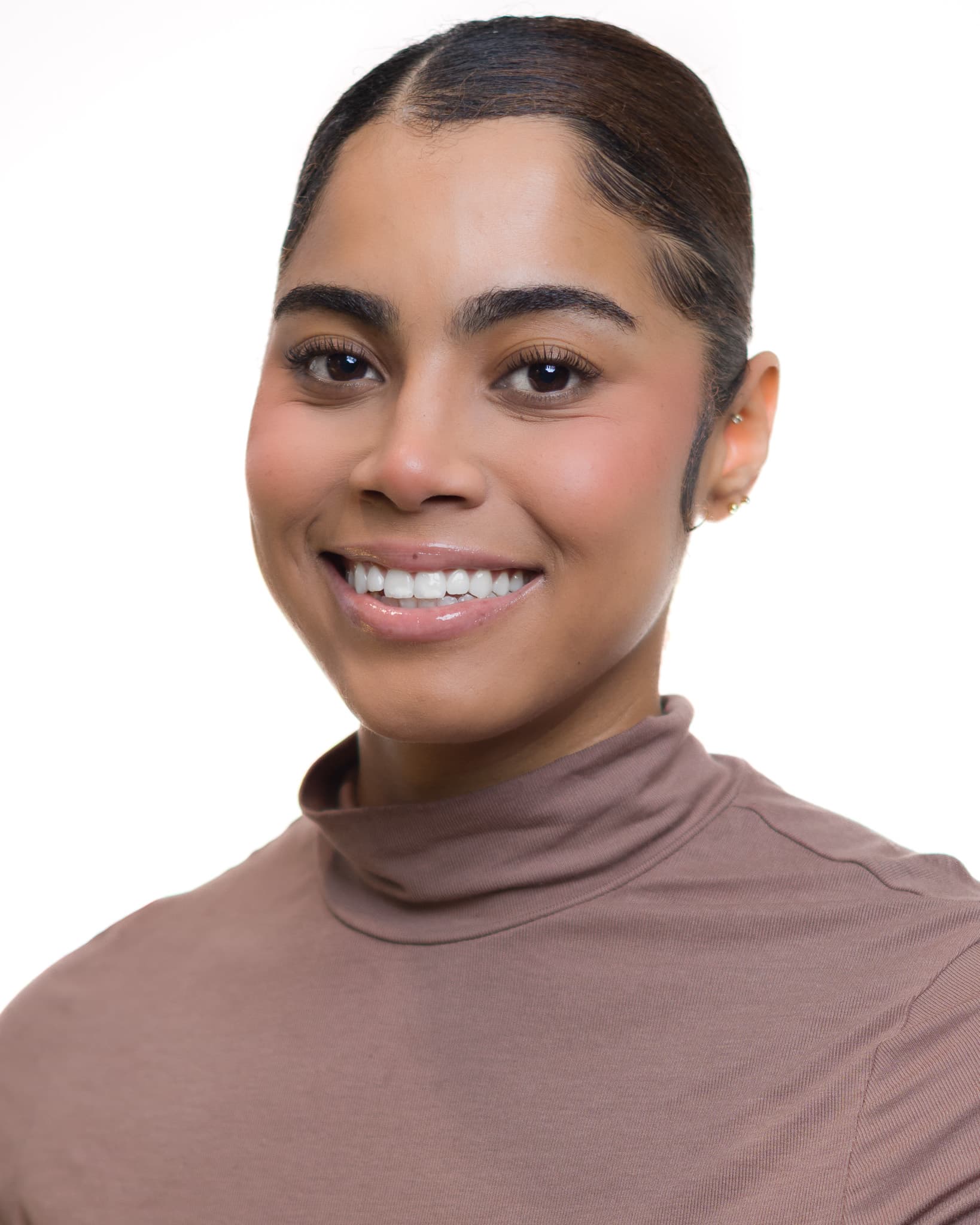
On-site event headshots are built to match a clean, modern corporate standard: even light, a neutral gray or white background, sharp eyes, and a natural expression. They are not moody editorial portraits. That's a different session in a controlled studio. The goal at an event is a photo that looks correct on a company website team page, a LinkedIn profile, a conference badge, and an internal directory, all at once.
People always ask whether event photos can look as good as studio photos. The honest answer: for a standard professional headshot, yes. A well-built booth and a real photographer produce results that are indistinguishable from a studio sitting for most uses. The difference shows up only when someone wants a fully custom background, multiple wardrobe changes, or a long art-directed session. For that, I point people back to the Fuentes Studio room in Riverdale rather than the event floor. For 95% of corporate needs, the booth is the right tool.
If your event is itself the product (a launch, a gala, a conference you want documented), the headshot booth often runs alongside broader event photography coverage, so you walk away with both clean portraits and candid shots of the room.
Retouching and delivery
What happens after the event matters as much as the booth itself, and it's where a lot of "we hired someone's friend" arrangements fall apart.
Every frame that leaves my booth gets a standard professional retouch: color correction, even skin tone, stray-hair cleanup, and blemish removal, while keeping the person looking like themselves. No plastic skin, no reshaped faces. For corporate work, restraint is the whole point: the photo has to still be recognizable at the front desk.
Photos come back through a private gallery, organized so each employee can find and download their own frames without your HR or marketing lead playing middleman. For larger events, I can deliver a single zipped, named-by-employee folder straight to whoever manages your directory.
When a booth makes sense, and when it doesn't
A booth is the right call when you have 15 or more people who all need a headshot, in one place, on one day. The per-person economics beat scheduling everyone into a studio individually, and the consistency is better than collecting whatever photos people already have.
A booth is the wrong call for one or two executives who need a polished, considered portrait. Pull those people into a proper studio sitting instead: they'll get more time, more direction, and a more deliberate result. Many companies do both: a booth for the broad team at the event, and individual corporate headshots for the leadership page. There's no rule that says it has to be one or the other.
How to plan a headshot booth for your NYC event
If you're the one who got handed "figure out the headshot thing," here's the short version of what I need from you to make it run smoothly:
- An approximate headcount, so we can size the booth hours or decide on a second station.
- The venue name and a photo of the proposed corner, plus confirmation of one power outlet nearby.
- Your hard start and end times for the booth window.
- A quick note on the look you want: most teams pick a clean light gray, but white and dark backgrounds are both easy.
- A point person on the day who can nudge people toward the line during a lull.
Give me those five things and the rest is on me. I'm based in Riverdale, in the Bronx, and I cover events across Manhattan, the Bronx, and the wider NYC area, so load-in logistics rarely involve a long haul.
Frequently asked questions
How much space does an on-site headshot booth need? Roughly a 10-by-10-foot footprint and one standard power outlet. A corner of a ballroom, a quiet section of a conference hall, or an unused meeting room all work. The booth needs enough depth for the subject to stand several feet off the backdrop.
How many headshots can you take per hour? Around 20 to 25 people per hour at a relaxed, directed pace, or up to 40 in a faster conveyor-style flow. For large headcounts on a tight clock, I run two stations in parallel so the line clears in time.
Can event headshots look as good as studio headshots? For a standard professional headshot, yes. A properly built booth with real lighting produces studio-quality results. The studio is only necessary for fully custom backgrounds, multiple wardrobe changes, or long art-directed portraits.
What does a headshot booth cost for a corporate event? It depends on headcount and booth hours rather than a flat per-photo price, so it's quoted per event. Tell me your headcount and window when you book your session and I'll scope an accurate quote the same day.
Book your event headshot booth
A headshot booth is one of the few line items at a corporate event that every single attendee actually uses afterward. Done right, it's invisible during the event and quietly useful for years. Done wrong, it's a line that backs up past the coffee. The difference is planning, and that's the part I handle.
Tell me your event date, venue, and headcount and I'll build a booth plan that fits the room and the clock. Book your session to start, or browse event photography coverage if you want the whole event documented alongside the headshots.
Looking to update your professional image? Fuentes Studio NYC headshot studio: sessions in Riverdale, NYC, booked as late as two days before.
Explore NYC Headshot Services
Sessions from $95, booked as little as two days ahead.
Related Reading

Ready to Create Something Beautiful?
Whether it's a portrait session, a brand shoot, or a commercial project. Let's bring your vision to life.